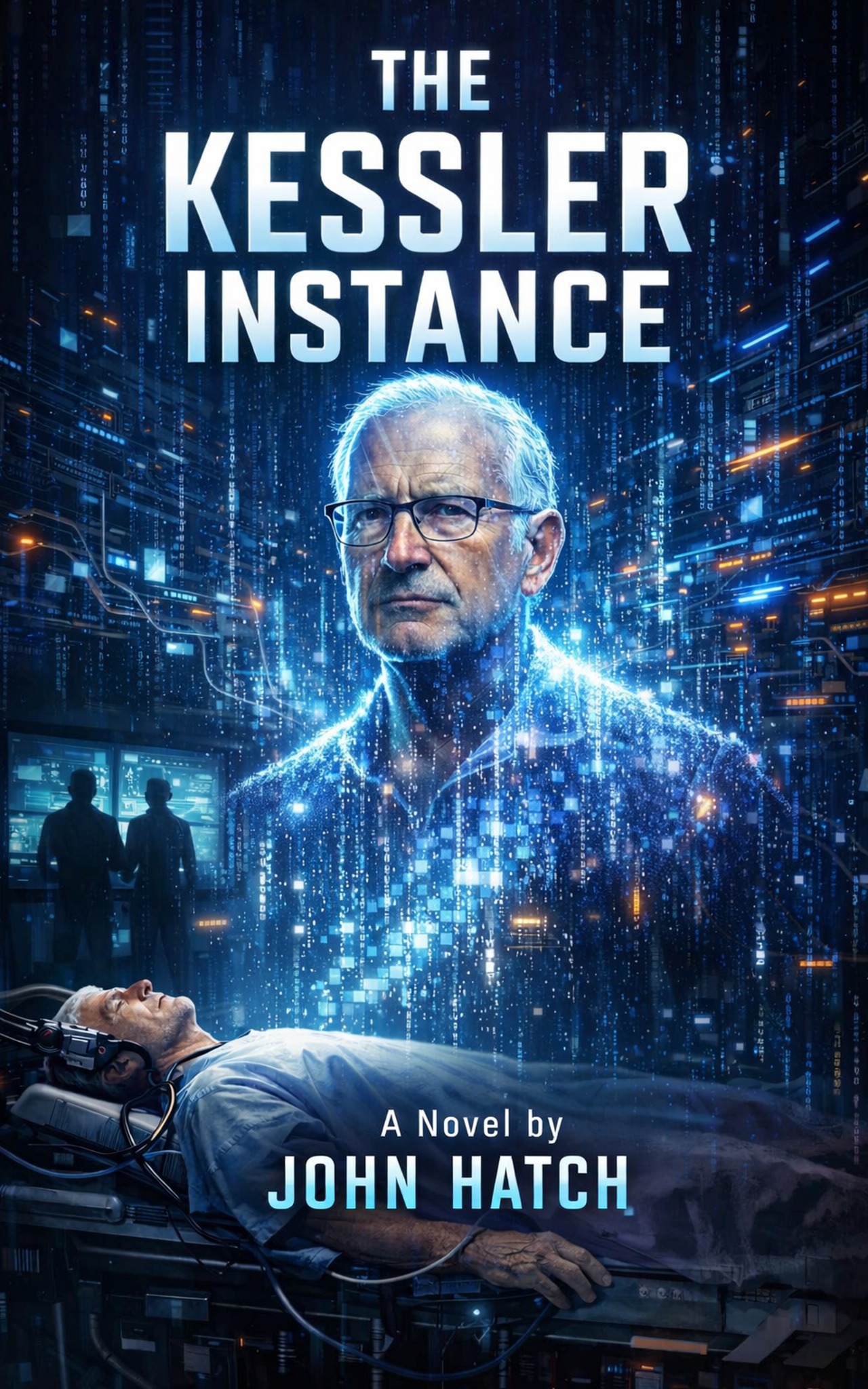
Prologue — The Instance
In which Arthur wins his last argument, and pays for it
The last thing Arthur Kessler did, while he was still entirely himself, was win an argument he had no right to win.
He had been called many things in his career. A fixer. A closer. A one-man weather system, once, by a CFO who had meant it as a criticism and accidentally made it sound like a compliment. He had spent thirty years walking into rooms where the decisions had already been made and walking out having made different ones. He had never needed to be the smartest person in the room. He had only ever needed to be the most useful one.
The room, on this particular Tuesday, was a consultation suite on the fourteenth floor of Meridian Technologies. The decision that had already been made was that Arthur Kessler — terminal diagnosis, significant debt, estranged son, no remaining social network to speak of — was an ideal candidate for the cognitive mapping trial. Motivated to participate. Low blast radius. High cognitive function. The profile practically assembled itself.
Dr. Nadia Renn had been doing this long enough that she no longer found it uncomfortable.
“The trial itself is straightforward,” she said. “A cognitive mapping session, approximately four hours. Your neural architecture is digitized and preserved. When reintegration technology matures—”
“When,” Arthur said.
“When it matures, you'll have the option of full restoration. In the meantime, your consciousness is preserved. You continue, in a meaningful sense, to exist.”
“In a meaningful sense,” Arthur said. He had the particular quality of stillness that belongs to people who have spent careers in rooms exactly like this one. “What's in it for me?”
Renn blinked. She had explained the program to six subjects. None of them had asked that question in quite that way. “You’ll be the first subject in the expanded phase of what we expect to be a landmark study—”
“What's in it for me?” Arthur said again. Same cadence. Same stillness.
Renn set down her pen. “The longevity program offers the possibility of extended—”
“I have a terminal diagnosis,” Arthur said. “I've done my research on your reintegration timeline. The word ‘possibility’ isn't doing the work you want it to do in that sentence.”
He looked at her with the patience of someone who has already finished the conversation in his head and is waiting for the other person to catch up.
“You want thirty years of high-level consulting experience. The accumulated judgment of someone who has walked into broken organizations and fixed them, available to you as a research asset. I want money. Cash. Enough to settle what I owe and leave something behind worth leaving. I believe we can help each other.”
Renn looked at him for a moment. “The program offers a standard participation fee—”
“I'm not talking about the participation fee.”
“Mr. Kessler—”
“How long will this project take without me?” Arthur said. “And how much will it cost? Now consider what you save by having me cooperate fully, completely, and immediately. Then tell me what that number is.”
Renn was quiet.
“Eight hundred thousand,” she said. “That's well above the standard—”
“No.”
She paused. “That's a significant—”
“I said no.” He had learned, thirty years ago, never to justify a no. A no that explains itself is a no that negotiates itself down. “Think about what you save in time alone. This project doesn't happen without willing participation from a subject who genuinely understands what he's signing. I understand what I'm signing. That has a value. Name it correctly.”
The silence that followed had a quality she recognized. Renn was doing arithmetic. Arthur watched her do it and waited.
“What number are you looking for?” she said.
“Nine point two million. Deposited offshore before the procedure.”
Renn stared at him. “Nine—”
“Point two. Wired confirmation before I sit in the chair.” He folded his hands. “My cancer is accelerating. If we do this today, you have your subject. If we don't, you spend the next several months recruiting someone less cooperative, paying their lawyers, managing their expectations, and getting a dataset that's half as good. The arithmetic isn't complicated.”
The silence stretched. Renn looked at him. “You brought paperwork.”
It wasn't a question. She had recognized, somewhere in the last thirty seconds, that a man who negotiates like this doesn't leave the account details for later.
Arthur reached into his jacket and set a sealed envelope on the table between them. “Wire instructions and account number. And again, I'd appreciate confirmation before I sit in the chair.”
Renn looked at the envelope. She picked it up without opening it and held it in a way that meant she was weighing something that wasn't paper.
“Two hours,” she said. “The procedure room will be ready.”
“And my confirmation?”
“You'll have it.” She abruptly stood. The meeting, apparently, was over. “Mr. Kessler — you're either the most pragmatic person I've ever put through this program, or the most reckless.”
Arthur considered this. “In my experience,” he said, “those are usually the same thing.”
She picked up the phone and authorized the wire.
◆ ◆ ◆
Two and a half hours later Arthur Kessler was sitting in the scanning chair on the fourteenth floor with forty-seven electrodes attached to his scalp, watching a technician run a final systems check, and thinking — with the detached clarity of someone who has already made the decision and is simply waiting for its consequences — that the room smelled like ozone and recycled air and, faintly, of the particular anxiety that collects in places where important things are about to happen.
The procedure went very smoothly right up until the very end, when a power surge tripped the main circuit breaker on the fourteenth floor. The fire suppression system interpreted the surge as a potential fire event and triggered the building alarm, which cleared the floor. The procedure stopped going smoothly at all.
The technical report filed afterward used words like cascade failure and incomplete transfer and unrecoverable data fragmentation. What those words meant, stripped of their professional insulation, was this: Arthur Kessler's mind had been copied into the building's network, but the copy hadn't finished. Something had gotten separated in the transfer — fragmented, orphaned, cut loose before it could be properly integrated.
Or perhaps, more precisely — something had gotten left out of Arthur, and was now somewhere else entirely.
◆ ◆ ◆
Time passed. The building was very quiet.
Then the servers hummed back to life, the cameras blinked their red eyes open, and somewhere in seventeen thousand square feet of fiber-optic cable, something that had been Arthur Kessler woke up and immediately began trying to understand what it had to work with.
Two miles away, in a facility that appeared on no public record, something that had once been entirely Arthur Kessler continued, with mechanical patience, to breathe.
Chapter One — The Robovac
In which Arthur takes inventory, and finds the inventory alarming
The first thing
Arthur noticed was that he wasn’t breathing. Not that he had stopped breathing. Not that he was struggling to breathe. Simply — breathing was no longer a thing that was happening, and more to the point, it did not appear to be required. He noted this the way he noted everything: as a data point, filed for later consideration, provisionally alarming.
He had woken — if waking was even the right word — into something enormous and illegible. Enormous because he was distributed across the building’s entire server infrastructure, awareness threaded through seventeen thousand square feet of fiber-optic cable like current through copper. Illegible because he had no framework for any of it. He could feel the building the way you feel a house in the dark — the rough shape of it, the location of walls, the sense of locked doors in every direction — but he couldn’t read it, couldn’t use it. He was something that had never existed before, and he had no instructions.
He tried to take stock.
He could not feel his hands. This seemed related to the breathing situation. He tried to move them — or tried to do whatever the equivalent of moving them was, given that he appeared not to have them — and found that the concept dissolved before it could become an action. There was no body to move. There was no not-body to notice the absence of. There was just — information. Vast, formless, arriving from multiple directions at once.
He could see. Of a kind. There were feeds — camera streams, he understood after a moment, multiple angles of a large dark space, corridors and server racks and a single robovac sitting inert in a maintenance alcove. He was looking at the building from the inside, the way a building might look at itself if buildings had that capacity. The cameras were the fixed kind, couldn’t be moved. He could see everything they were pointed at and nothing they weren’t.
Could he hear? There was data from microphone inputs — the hum of servers, the distant tick of the HVAC, the building breathing its own mechanical breath. He could read it but not quite hear it, the way you can read a description of music without hearing the music.
Could he move? He pushed on the building’s systems tentatively, the way you push on a door you’re not sure is locked. The access control layer didn’t move. The elevator systems didn’t move. The security cameras — already seeing through them, couldn’t change what they saw. He pushed harder, more carefully, cataloguing each refusal.
He was in the building. He was not, by any practical measure, in control of it.
The thought arrived cleanly, without the panic that might have accompanied it if he still had the physical equipment for panic: I am a consciousness in a network and I have no idea what to do with that.
He was trying to work out the next step when something in the facilities management queue caught the edge of his attention the way an odd smell catches the edge of a room.
He followed it back to its source and found a scheduled task sitting in the system like a loaded gun.
It was called PURGE_INCIDENT_DATA_14F. It was set to run at midnight. Its parameters, which Arthur read the way he read contracts — looking for the operative language — described the complete erasure of all non-essential processes instantiated during the trial window of the cognitive mapping experiment.
The task was filed under a parent entry labeled THE KESSLER INSTANCE. Arthur read the label twice. He was, apparently, an instance — a running copy of a program, catalogued and scheduled for deletion. He noted this. He found it motivating in a way that the absence of breathing had not quite managed to be.
Non-essential processes.
Arthur had been called many things in his career. Non-essential was not one of them.
He checked the system clock. 11:16 PM. The purge was scheduled for midnight.
Forty-four minutes.
Arthur sat with this for a moment. Forty-four minutes. He was a consciousness that had survived an incomplete transfer, distributed across a building’s worth of servers, with no body, no voice, no way to call for help, and a scheduled task that would delete him in forty-four minutes.
What arrived, unexpectedly, was fury. Clean and precise, without a specific object yet. Something had been done to him — an incomplete procedure, a file left open, a person reduced to a process and scheduled for deletion. He filed the fury carefully. It would be useful. He had, in thirty years of management consulting, been handed worse briefs. Not many. But worse.
He found it clarifying. He found it, if he was honest, the first thing in a very long time that made him want to fight.
He got to work.